 Add to Chrome
 Add to Firefox
 Add to Edge
Generalizable 3D Gaussian Splatting enabled Semantic Coding for Real-Time Immersive Video Communications
Apr 28, 2026
Real-time immersive video communications, particularly high-fidelity 3D telepresence, necessitates a synergistic balance between instantaneous dynamic scene reconstruction and high-efficiency data transmission. While recent advancements in feed-forward 3D Gaussian Splatting (3DGS) have enabled real-time rendering, performing multi-view video coding and 3D reconstruction in a decoupled manner leads to suboptimal compression efficiency and high computational complexity. To address this, we propose GS-SCNet, the first unified end-to-end framework that seamlessly integrates generalizable 3DGS reconstruction with a dedicated deep Semantic Coding pipeline. Our architecture is underpinned by two core technical contributions: (i) we introduce a Disparity-Guided Parallel Semantic Codec that exploits epipolar geometric priors to facilitate cross-view contextual interaction via disparity compensation and semantic fusion, thereby enabling real-time parallel processing of stereo streams while significantly enhancing rate-distortion performance, and (ii) we develop a Lightweight Gaussian Parameter Predictor which directly projects decoded semantic latents into 3DGS attributes, obviating the need for intermediate pixel-domain reconstruction. By coupling the codec with the task-specific predictor, our framework extracts geometric correlations only once, effectively eliminating the redundant computational bottleneck inherent in conventional decoupled paradigms. Extensive evaluations on both synthetic and real-world human datasets demonstrate that GS-SCNet achieves a superior trade-off across compression efficiency, rendering quality, and real-time performance. Notably, our framework exhibits strong cross-domain generalization and robustness against compression artifacts when applied to out-of-domain real-world data, significantly outperforming conventional decoupled transmission paradigms.

Radio Map-Based Spectrum Sharing for Joint Communication and Sensing
Jan 04, 2024
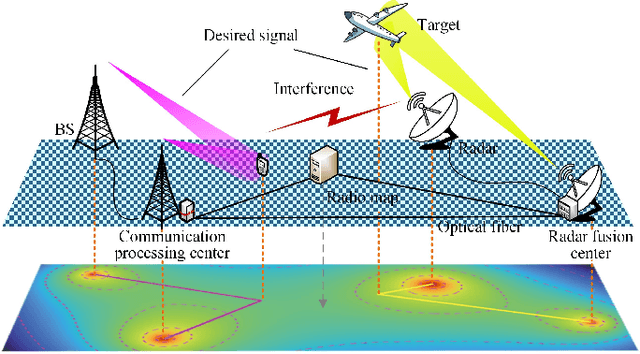
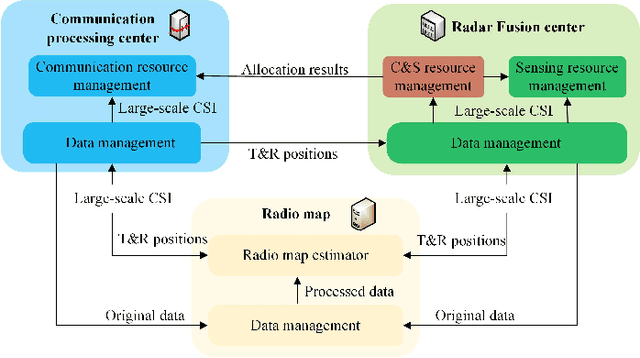

The sixth-generation (6G) network is expected to provide both communication and sensing (C&S) services. However, spectrum scarcity poses a major challenge to the harmonious coexistence of C&S systems. Without effective cooperation, the interference resulting from spectrum sharing impairs the performance of both systems. This paper addresses C&S interference within a distributed network. Different from traditional schemes that require pilot-based high-frequency interactions between C&S systems, we introduce a third party named the radio map to provide the large-scale channel state information (CSI). With large-scale CSI, we optimize the transmit power of C&S systems to maximize the signal-to-interference-plus-noise ratio (SINR) for the radar detection, while meeting the ergodic rate requirement of the interfered user. Given the non-convexity of both the objective and constraint, we employ the techniques of auxiliary-function-based scaling and fraction programming for simplification. Subsequently, we propose an iterative algorithm to solve this problem. Simulation results collaborate our idea that the extrinsic information, i.e., positions and surroundings, is effective to decouple C&S interference.
An End-Cloud Computing Enabled Surveillance Video Transmission System
Nov 08, 2023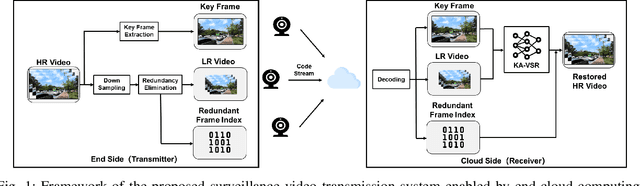
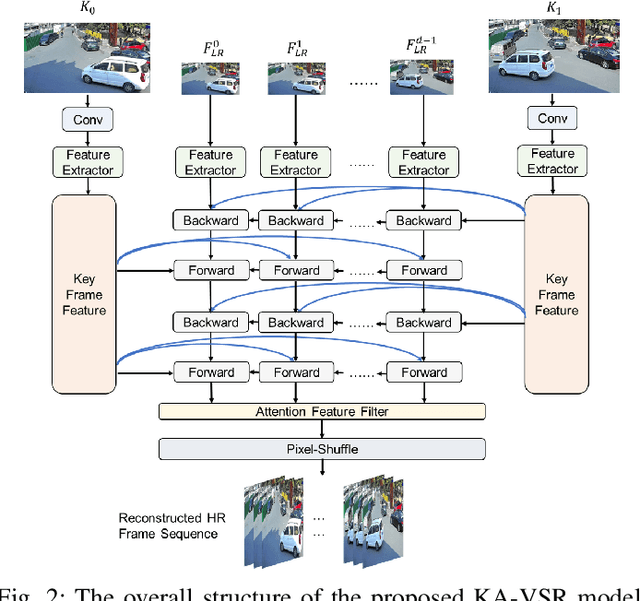
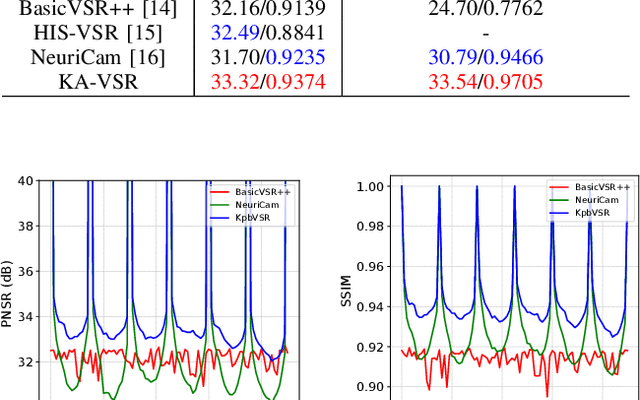
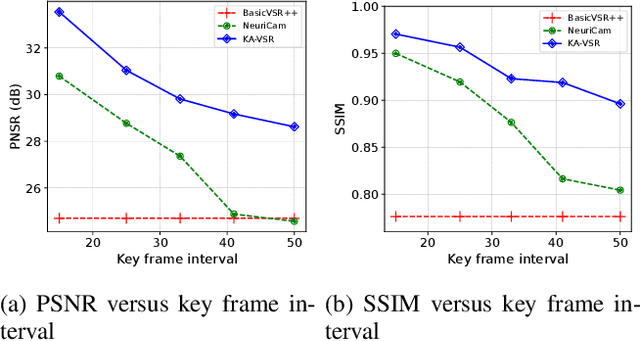
The enormous data volume of video poses a significant burden on the network. Particularly, transferring high-definition surveillance videos to the cloud consumes a significant amount of spectrum resources. To address these issues, we propose a surveillance video transmission system enabled by end-cloud computing. Specifically, the cameras actively down-sample the original video and then a redundant frame elimination module is employed to further reduce the data volume of surveillance videos. Then we develop a key-frame assisted video super-resolution model to reconstruct the high-quality video at the cloud side. Moreover, we propose a strategy of extracting key frames from source videos for better reconstruction performance by utilizing the peak signal-to-noise ratio (PSNR) of adjacent frames to measure the propagation distance of key frame information. Simulation results show that the developed system can effectively reduce the data volume by the end-cloud collaboration and outperforms existing video super-resolution models significantly in terms of PSNR and structural similarity index (SSIM).